

Types of Market Research Explained and How to Use Them
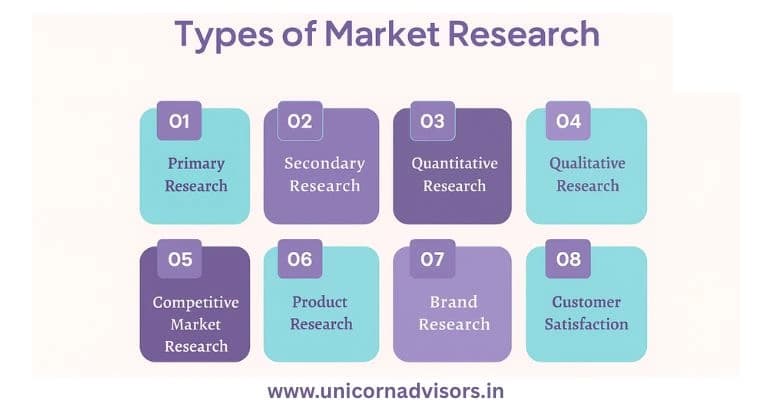
Learn the different types of market research and how businesses can use them to understand customers, analyze competitors, improve products, and make data-driven decisions.
Types of Market Research Explained and How to Use Them
Understanding your target audience is the foundation of every successful business strategy. Whether you are launching a new product, entering a new market, improving customer experience, or strengthening your brand, market research provides the insights needed to make informed decisions.
At Unicorn Advisors, we help businesses transform data into actionable strategies through comprehensive market research and business intelligence solutions. This guide explains the major types of market research and how businesses can use them effectively to drive growth and improve decision-making.
What is Market Research?
Market research is the process of collecting, analyzing, and interpreting information about customers, competitors, industry trends, and market conditions.
The objective of market research is to help businesses understand:
- Customer needs and preferences
- Market opportunities
- Industry trends
- Competitive positioning
- Consumer behavior
- Product demand
These insights enable organizations to make strategic decisions based on evidence rather than assumptions.
Why Market Research Matters
Before investing resources into new products, marketing campaigns, or expansion plans, businesses need answers to important questions such as:
- Who are your customers?
- What problems are they trying to solve?
- What influences their purchasing decisions?
- What are competitors offering?
- Which market trends are shaping the industry?
Market research helps answer these questions with reliable data, reducing uncertainty and improving business outcomes.
Organizations that consistently invest in research are often better positioned to identify opportunities, respond to market changes, and maintain a competitive advantage.
Types of Market Research and How to Use Them
Different research methods serve different business objectives. Understanding the strengths of each approach helps businesses select the right strategy.
1. Primary Research
Primary research involves collecting original data directly from your target audience.
This approach provides first-hand information that is specific to your business objectives and customer base.
Common Primary Research Methods
- Surveys and questionnaires
- Customer interviews
- Focus groups
- Product testing
- Field research
- Observational studies
How to Use Primary Research
Primary research is ideal for:
- Testing new product concepts
- Measuring customer satisfaction
- Evaluating brand perception
- Understanding customer preferences
- Gathering direct customer feedback
Because the data comes directly from your audience, it is often highly relevant and actionable.
2. Secondary Research
Secondary research involves analyzing information that has already been collected and published by other organizations.
This approach is often used to gather industry-level insights and understand broader market trends.
Common Sources of Secondary Research
- Government reports
- Industry publications
- Market research reports
- Academic studies
- Competitor websites
- Business journals
- Whitepapers and case studies
How to Use Secondary Research
Secondary research is valuable for:
- Market trend analysis
- Industry benchmarking
- Competitive analysis
- Opportunity assessment
- Business planning
It provides a cost-effective way to gain market intelligence before conducting primary research.
3. Quantitative Research
Quantitative research focuses on numerical data and measurable outcomes.
The goal is to identify patterns, trends, and statistical relationships that support objective decision-making.
Common Quantitative Research Methods
- Structured surveys
- Online questionnaires
- Customer databases
- Website analytics
- Sales performance analysis
- Market segmentation studies
How to Use Quantitative Research
Businesses use quantitative research to:
- Measure customer satisfaction
- Evaluate product demand
- Assess campaign performance
- Track market share
- Analyze purchasing behavior
Quantitative research provides statistical evidence that supports strategic business decisions.
4. Qualitative Research
Qualitative research focuses on understanding the motivations, opinions, emotions, and behaviors that influence customer decisions.
Rather than measuring data numerically, qualitative research explores the reasons behind customer actions.
Common Qualitative Research Methods
- In-depth interviews
- Focus groups
- Customer discussions
- Ethnographic studies
- User experience research
- Online communities
How to Use Qualitative Research
Qualitative research is particularly useful for:
- Brand development
- Product innovation
- Customer journey mapping
- User experience improvement
- Understanding buying behavior
These insights help businesses create products, services, and experiences that better meet customer expectations.
5. Competitive Market Research
Competitive research focuses on understanding competitors and identifying opportunities within the marketplace.
Areas of Competitive Analysis
- Product offerings
- Pricing strategies
- Marketing activities
- Customer reviews
- Brand positioning
- Digital presence
How to Use Competitive Research
Businesses use competitive research to:
- Identify market gaps
- Refine positioning strategies
- Improve products and services
- Benchmark performance
- Develop competitive advantages
A clear understanding of competitors helps businesses differentiate themselves effectively.
6. Product Research
Product research helps businesses determine whether a product concept meets market demand before significant investments are made.
Key Areas of Product Research
- Concept testing
- Feature evaluation
- Pricing analysis
- Packaging feedback
- Product usability testing
- Customer acceptance studies
How to Use Product Research
Product research helps businesses:
- Reduce launch risks
- Improve product-market fit
- Prioritize features
- Optimize pricing strategies
- Increase customer satisfaction
Early feedback often leads to stronger and more successful product launches.
7. Brand Research
Brand research measures how customers perceive a business and its offerings.
Understanding brand perception helps organizations strengthen their market position and improve customer engagement.
Brand Research Areas
- Brand awareness
- Brand perception
- Brand recall
- Brand loyalty
- Customer sentiment
- Brand positioning
How to Use Brand Research
Businesses can use brand research to:
- Improve messaging
- Refine brand identity
- Enhance customer trust
- Monitor brand reputation
- Strengthen competitive positioning
Regular brand evaluations help ensure consistency and long-term relevance.
8. Customer Satisfaction and Loyalty Research
Customer retention is often more cost-effective than acquiring new customers.
Customer satisfaction research helps organizations understand how well they meet customer expectations.
Common Customer Satisfaction Metrics
Net Promoter Score (NPS)
Measures customer willingness to recommend your business to others.
Customer Satisfaction Score (CSAT)
Measures overall satisfaction with products, services, or experiences.
Customer Effort Score (CES)
Evaluates how easy it is for customers to interact with your business.
How to Use Customer Satisfaction Research
Businesses can use customer feedback to:
- Improve service quality
- Increase customer retention
- Enhance customer experiences
- Reduce customer churn
- Build stronger relationships
Continuous feedback helps organizations adapt and improve over time.
How to Choose the Right Type of Market Research
Selecting the right research method depends on several factors.
Business Objectives
Consider whether your goal is to:
- Launch a new product
- Enter a new market
- Improve customer experience
- Increase brand awareness
- Analyze competitors
Budget and Resources
Different research approaches require varying levels of investment and expertise.
Target Audience
The characteristics of your audience influence which research methods are most effective.
Product or Business Lifecycle Stage
Research needs often vary depending on whether a business is:
- Starting up
- Growing
- Expanding
- Repositioning
- Launching new products
In many cases, combining qualitative and quantitative research provides the most comprehensive insights.
Why Businesses Choose Unicorn Advisors
At Unicorn Advisors, we provide customized market research solutions that help businesses make informed and confident decisions.
Our services include:
- Consumer research
- Market analysis
- Competitive intelligence
- Product research
- Brand studies
- Customer satisfaction surveys
- Business intelligence solutions
- Data analytics and reporting
We combine advanced analytical tools with industry expertise to deliver actionable insights that support measurable business growth.
Conclusion
Market research is no longer optional in today's competitive business environment. It is a critical tool for understanding customers, identifying opportunities, reducing risks, and making strategic decisions.
From primary and secondary research to customer satisfaction studies and competitive analysis, each type of market research serves a unique purpose and contributes valuable insights.
By selecting the right research methods and leveraging reliable data, businesses can improve decision-making, strengthen market positioning, and achieve sustainable growth.
Partner with Unicorn Advisors to unlock the power of market research and transform data into strategic business success.
Need Professional Business Advisory?
Connect with Tanmay Mehta and our advisory board for tailored consulting services.
- GIDC Land Allotment & Compliance
- Government Subsidies & Incentives
- Market Research & Feasibility Surveys
- MSME & Startup Strategy Development